
Joinery
Bespoke joinery or standard furniture: how to choose?

Bookcase, dressing room, entrance cabinet: the criteria for choosing between standard furniture and bespoke joinery built into the renovation.
Standard furniture is available straight away and suits many situations. Bespoke is justified when the space, the use or the architecture of the room calls for it. A few questions help decide.
Is the space standard?
Walls out of plumb, sloping ceilings, alcoves, high ceilings, partition returns: off-the-shelf furniture leaves gaps or bumps into a skirting board or a cornice. A bespoke piece fills the volume exactly.
Is the furniture part of the architecture?
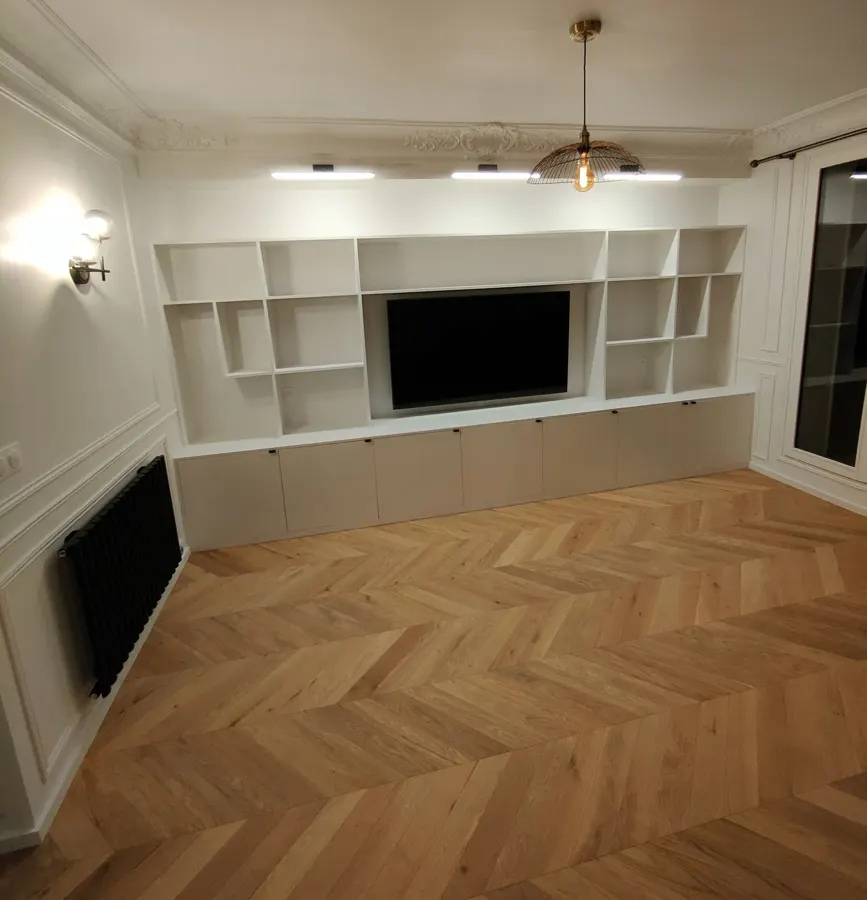
A full-height bookcase, a window seat or a glass partition become features of the room. They are designed together with the mouldings, doors and lighting, and are often painted in the wall colour.
Which precise uses?
Books of different formats, a screen to build in, entrance storage with a bench and coat hooks, a dressing room with long hanging: the more precise the use, the more bespoke brings.
The right moment: during the renovation
Building the joinery into the design from the start makes it possible to place sockets, lighting and reinforcements in the right place, and to avoid rework. That is the value of a company that carries out both the renovation and the joinery.
From drawing to installation
A drawing makes it possible to validate proportions and uses before manufacture. Compare the drawing with the completed entrance cabinet.
Further reading
- Preparing the full renovation of an apartment or a house
- Renovating an older apartment while preserving its mouldings
- Renovating an apartment in a shared building: what to know before the works
- Electrics in the bathroom: understanding the safety zones
- Installing an interior glass partition: the right questions to ask
- Kitchen electrics: sockets and circuits to plan
- Chevron, herringbone, straight lay: recognising parquet patterns
- Renovating a bathroom: the order of works