
Haussmann
Chevron, herringbone, straight lay: recognising parquet patterns

Chevron, herringbone, straight lay or staggered lay: how to recognise parquet patterns and what they change in a renovation.
Parquet gives an older apartment much of its character. Knowing how to recognise its pattern helps decide whether to restore it, complete it or replace it.
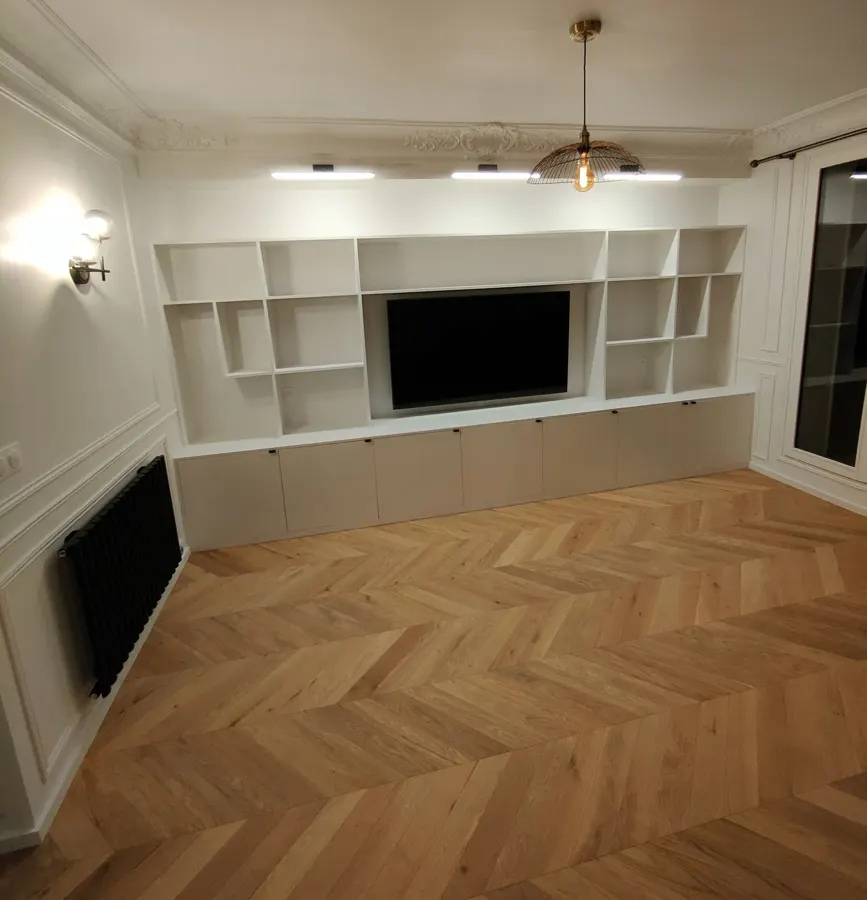
Chevron (point de Hongrie)
The boards are cut at an angle at their ends and meet to form continuous chevrons, like a series of arrows. It is the emblematic pattern of Haussmann apartments.
Herringbone (bâton rompu)
The boards, cut square, are laid perpendicular to one another: the end of one board sits against the side of the next. The pattern also recalls chevrons, but stepped.
Straight lay and staggered lay
The boards are laid in parallel. In a straight lay (à l'anglaise), their ends are offset freely; in a staggered lay (à coupe de pierre), the offset is regular, like the joints of a stone wall.
Restore or complete
Old parquet can often be sanded and varnished or oiled. When a partition is moved, missing boards are added so the pattern continues. The pattern is chosen before the skirting boards and joinery.
See Haussmann renovation and the renovation glossary.
Further reading
- Preparing the full renovation of an apartment or a house
- Renovating an older apartment while preserving its mouldings
- Bespoke joinery or standard furniture: how to choose?
- Renovating an apartment in a shared building: what to know before the works
- Electrics in the bathroom: understanding the safety zones
- Installing an interior glass partition: the right questions to ask
- Kitchen electrics: sockets and circuits to plan
- Renovating a bathroom: the order of works